The Birth of an Industrial Cathedral
Construction of Battersea Power Station began in March 1929, when the London Power Company broke ground on what would become one of the world's largest brick buildings. The A Station, completed in 1935 at a cost of £2,141,550, featured the architectural vision of J. Theo Halliday and engineering by Leonard Pearce, with Sir Giles Gilbert Scott consulting on the exterior design; Scott's portfolio included Liverpool Anglican Cathedral and the red telephone box. The B Station followed after the Second World War, with construction beginning in 1945 and operations starting gradually between 1953 and 1955.
At its peak, the power station consumed over one million tonnes of coal annually, delivered by coastal colliers from South Wales and North East England. The A Station's 105 MW generator was the largest in Europe at the time of installation. When the B Station opened, the complex became the most thermally efficient power station in the world and the third largest generating site in the United Kingdom, supplying one fifth of London's electricity and employing approximately 1,000 people.
The building's dimensions remain striking: 160 metres by 170 metres, with a boiler house roof exceeding 50 metres in height. The four chimneys, each 103 metres tall, were constructed from concrete rather than brick. Inside, the A Station featured Art Deco fittings that belied its industrial purpose: Italian marble in the turbine hall, polished parquet floors, and wrought-iron staircases. The architectural style earned the building its nickname as a "brick cathedral."
Decline and Decades of Uncertainty
The A Station closed on 17 March 1975 after 40 years of operation. The B Station followed on 31 October 1983, having operated for nearly 30 years. The closures came as equipment aged, operating costs increased (particularly for flue gas cleaning), and the national energy mix shifted from coal toward oil, gas, and nuclear alternatives.
Recognition of the building's significance came before the final closure. On 14 October 1980, Secretary of State Michael Heseltine granted Grade II listed status. This was upgraded to Grade II* in 2007, providing the highest level of heritage protection short of Grade I. Despite this protection, the building remained empty for more than 30 years.
The period of decline was marked by failed redevelopment proposals. In the 1980s, Alton Towers proposed an indoor theme park with projected costs between £35 million and £230 million; the scheme halted in 1989 due to funding shortages, and the roof was removed, leaving the steel framework exposed to the elements. In 1993, Hong Kong-based Parkview International purchased the site for £10 million and proposed a £1.1 billion redevelopment, but this scheme also stalled.
By 1991, the building had been added to the Heritage at Risk Register. In 2004, it appeared on the World Monuments Fund watch list. English Heritage described its condition as "very bad" in 2008. The structure that had powered a fifth of London had become one of its most endangered landmarks.
The Malaysian Consortium and a New Vision
In November 2006, Irish developers Real Estate Opportunities and Treasury Holdings purchased the site for £400 million, appointing Rafael Viñoly as master planner and proposing 3,200 homes, office space, and a biomass power station. This scheme collapsed when REO went into administration in November 2011, with Lloyds Bank and Ireland's National Asset Management Agency calling in the debt.
The turning point came in June 2012, when a Malaysian consortium comprising S P Setia, Sime Darby, and the Employees Provident Fund purchased the site for £400 million. The consortium committed £200 million toward extending the Northern line, a transport link that would prove essential to the development's viability.
Final approval for the Northern line extension came in November 2014 from the Secretary of State for Transport. Construction began in 2015, with tunnel boring machines named "Helen" and "Amy" (after Helen Sharman and Amy Johnson) excavating the route. The £1.1 billion project, which opened on 20 September 2021, was the first major Underground extension since the Jubilee Line Extension in 1999 and finished £160 million under budget. Two new stations were created: Nine Elms and Battersea Power Station, both in Zone 1.
The power station building itself required £150 million in restoration costs. All four chimneys were rebuilt "like for like" following a 2005 assessment that found the original reinforcement had corroded. The Art Deco interior fittings were restored, and the building fabric was painstakingly preserved.
Wandsworth and the Local Impact
The power station sits within the London Borough of Wandsworth, forming part of the Vauxhall, Nine Elms, Battersea Opportunity Area. The redevelopment has had significant implications for Wandsworth residents, though not without controversy.
In July 2017, Wandsworth Council agreed to reduce the affordable housing requirement from 15 per cent to 9 per cent of the development, citing the £266.4 million contribution toward the Northern line extension. Mayor of London Sadiq Khan described the reduction as "shameful." The tension between infrastructure investment and social housing obligations remains a point of local debate.
Transport statistics illustrate the area's transformation. In the first year of operation to September 2022, the Northern line extension recorded over five million journeys. The Battersea Power Station tube station alone averaged 80,000 trips per week in its first year, and by 2024, the station recorded 9.23 million entries and exits. Transport for London had estimated demand could reach 10 million yearly by 2024/25. The station connects to National Rail services at Battersea Park and Queenstown Road (Battersea), improving accessibility across South West London.
The wider opportunity area encompasses plans for 16,000 new homes, 500,000 square metres of commercial space, and projections of 27,000 new jobs. For Wandsworth's population of 337,655 residents (2024), the development represents both opportunity and pressure on local services.
From Coal to Culture: The Power Station Today
The main power station building opened to the public in October 2022, completing a transformation from energy generation to cultural consumption. The site now hosts over 150 shops, bars, and restaurants within the power station and along Electric Boulevard, open from 10am to 8pm Monday through Saturday and 12pm to 6pm on Sundays.
Major commercial tenants have established significant presences. Apple announced its London campus at the power station in July 2021, joining SharkNinja and The Engine Room co-working space. The recently completed 50 Electric Boulevard provides 200,000 square feet of office accommodation, with units from 10,500 square feet available.
The cultural offerings extend beyond retail. The Cinema in the Power Station operates within the restored building, while exhibitions such as "Ramses and the Pharaoh's Gold" have brought 180 priceless treasures from the Egyptian Museum in Cairo. The Battersea Power Station Community Choir and educational programmes for schools demonstrate attempts at community engagement through the BPS Foundation.
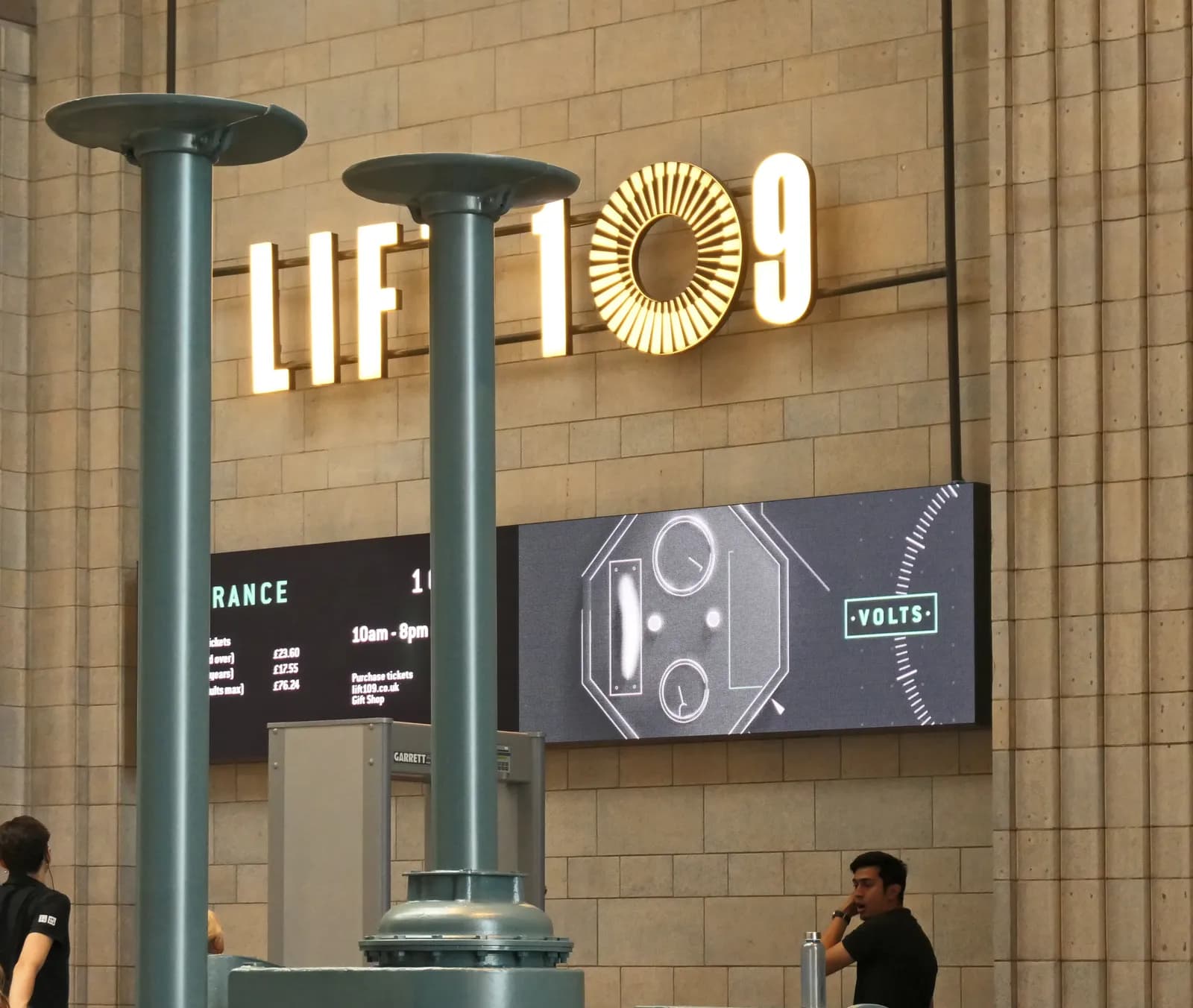
The most dramatic addition is Lift 109, a glass elevator installed within the north-west chimney that transports visitors 109 metres to a 360-degree viewing platform overlooking the London skyline. The experience begins in the Art Deco Turbine Hall A, where curated displays document the building's history.
In November 2022, the power station was awarded the Architects' Journal Architecture Award for Infrastructure and Transport, recognition of both the engineering achievement and the quality of the restoration.
What the Future Holds
The residential component of the development includes multiple phases: Circus West Village, Prospect Place, Battersea Roof Gardens, The Power Station, and Koa at Electric Boulevard. Marketing materials indicate that many phases are sold out, with limited availability remaining in certain developments.
The Battersea Power Station that defined an era of coal-fired electricity generation now defines an era of adaptive reuse and heritage-led regeneration. Whether viewed from the Northern line platform at the new tube station, from the south bank of the Thames, or from the top of Lift 109, the four chimneys remain visible across Wandsworth and beyond. The building that powered London has been transformed, but its presence on the skyline endures as a reminder of the area's industrial past and its uncertain, expensive, and ultimately successful journey back to relevance.
The 42-acre site stands as both a monument to twentieth-century engineering and a case study in twenty-first-century urban redevelopment. For Wandsworth residents, it is a landmark that now provides employment, retail, and entertainment opportunities, even as questions about housing affordability and community benefit continue to be asked.