A Victorian Memorial Rises on Wandsworth Common
The Royal Victoria Patriotic Building stands on John Archer Way at the edge of Wandsworth Common as one of south London's most architecturally distinctive structures. Built between 1857 and 1859, this Grade II* listed Gothic Revival complex has served as an orphan asylum, a military hospital, a Second World War interrogation centre, and a derelict ruin before its current incarnation as a mixed-use residential and cultural space.
Foundation and Construction
The building owes its existence to the Crimean War. Following the conflict's end in 1856, Prince Albert established the Royal Patriotic Fund through public subscription, raising nearly £1.5 million to support the families of fallen soldiers. A portion of these funds—£35,000—was allocated to construct an asylum for orphan daughters of servicemen killed in the campaign.
Queen Victoria laid the foundation stone on 11 July 1857. The commission went to Major Rohde Hawkins, a Victorian architect known for Gothic church designs, whilst builder George Myers of Lambeth oversaw construction. Work proceeded rapidly; the building was completed in just 18 months, and the first orphan residents arrived on 1 July 1859.
Architectural Character
Hawkins created an eclectic composition blending Scottish Baronial, Jacobean, and French Châteauesque elements. The structure is built from yellow brick with York stone dressings, arranged around two courtyards separated by a central hall. Five major towers punctuate the roofline, three positioned at the front elevation, each capped with steep pyramidal roofs. The central tower features a three-storey stone frontispiece containing a statue of St George and the Dragon.
The interior originally featured an elaborate hammer beam ceiling in the main hall, painted in three sections by decorative artist J.G. Crace. This ceiling would later be destroyed by fire, then meticulously reconstructed using photographic documentation.
From Asylum to Hospital: The First World War
For its first fifty-five years, the building operated as the Royal Victoria Patriotic School, housing and educating girls orphaned by military service. Historical records indicate conditions were often harsh; the institution suffered an abuse scandal resulting in the death of one orphan.
The First World War brought a dramatic shift in purpose. The War Office requisitioned the building in 1914, converting it into the 3rd London General Hospital under the Royal Army Medical Corps. The field behind the building held approximately 1,800 patients in marquee wards at peak capacity. Renovations included reinforced roof trusses, Westmorland slate replacement, and a new heating system.
The Intelligence Era: Second World War Interrogations
Perhaps the building's most intriguing chapter occurred between 1939 and 1945, when it served as the London Reception Centre, an alien clearing station operated by MI6 (the Secret Intelligence Service). Located discreetly on Wandsworth Common, away from central London's bustle, the centre processed 34,000 civilians arriving from Nazi-occupied Europe.
Each arrival underwent questioning to identify potential German agents. Of those processed, fewer than 300 faced further detention, with approximately fifty confirmed as enemy agents and transferred to Camp 020 for deeper interrogation. Colonel Oreste Pinto, the legendary MI5 interrogator nicknamed the "spycatcher," maintained his headquarters here. Thousands of interview records from this period survive at The National Archives.
Decline and Dereliction
Following the Second World War, the building housed a teacher training college from 1945 to 1952. The London County Council purchased the property for £67,500, establishing Honeywell Secondary Mixed School in 1955, followed by Spencer Park Comprehensive School for Boys. By 1974, structural engineers deemed the building unsafe due to dry rot, and the school closed.
The subsequent six years saw rapid deterioration. Pigeon infestation, lead theft from roofs, and vandalism left the Victorian edifice crumbling. Demolition seemed likely until intervention by the Victorian Society and Wandsworth Society secured Grade II* listing in October 1973.
Restoration and Rebirth
In 1980, the Greater London Council granted a lease with a £1 freehold option to Tuberg Property Company, initiating a six-year restoration programme. Disaster struck weeks before handover when arson destroyed the main hall's historic hammer beam ceiling. Remarkably, a complete photographic survey had been completed just two weeks prior; restorers used these images to reconstruct the ceiling with exacting accuracy.
The restoration earned significant recognition: a Civic Trust commendation for the hall ceiling in 1985, a further Civic Trust commendation for the full restoration in 1987, and the Europa Nostra Order of Merit the same year.
Present Day: A Living Building
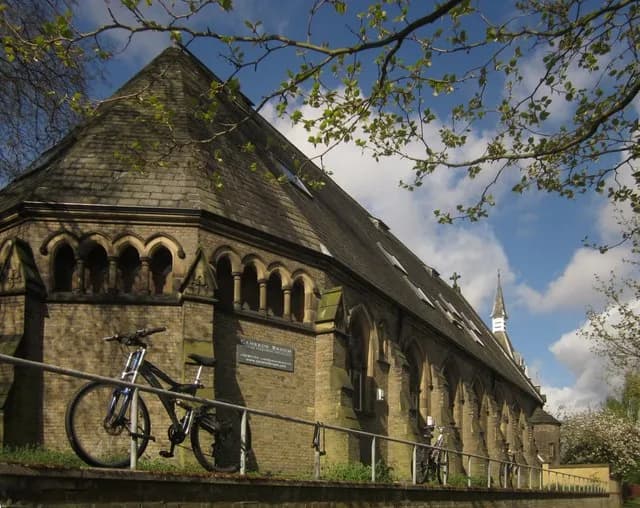
Today the Royal Victoria Patriotic Building contains approximately twenty-seven residential flats, twenty studios, fifteen workshops, and two large office units in the former chapel. The Academy of Live and Recorded Arts (ALRA) occupies the two principal halls and additional spaces, operating one of London's respected drama schools.
Le Gothique restaurant, housed within the building, hosts the Wandsworth Common Beer Festival twice yearly, drawing visitors from across south-west London. The building stands as a testament to adaptive reuse; a Victorian charitable institution transformed into a thriving mixed-use community, its towers still visible across Wandsworth Common as they have been for over 160 years.